How an ROI Dashboard Solves Real Problems for HVAC Companies
How an ROI Dashboard Solves Real Problems for HVAC Companies And Why Understanding ROI Potential vs. ROI Closed Will Transform Your Team’s Performance
Running an HVAC company today is more complex than ever. Competition is fierce, consumers shop online before they ever pick up the phone, and marketing costs—from Google ads to LSAs to direct mail—continue rising every year. Meanwhile, HVAC business owners are expected to make fast, data-driven decisions in a landscape where the data is often confusing, scattered, or downright misleading.
At All Contractor Marketing, we’ve spent nearly two decades helping HVAC companies grow, scale, and dominate their local markets. Over those years, one thing has remained true:
The HVAC companies that win know their numbers—and the ones that struggle usually don’t.
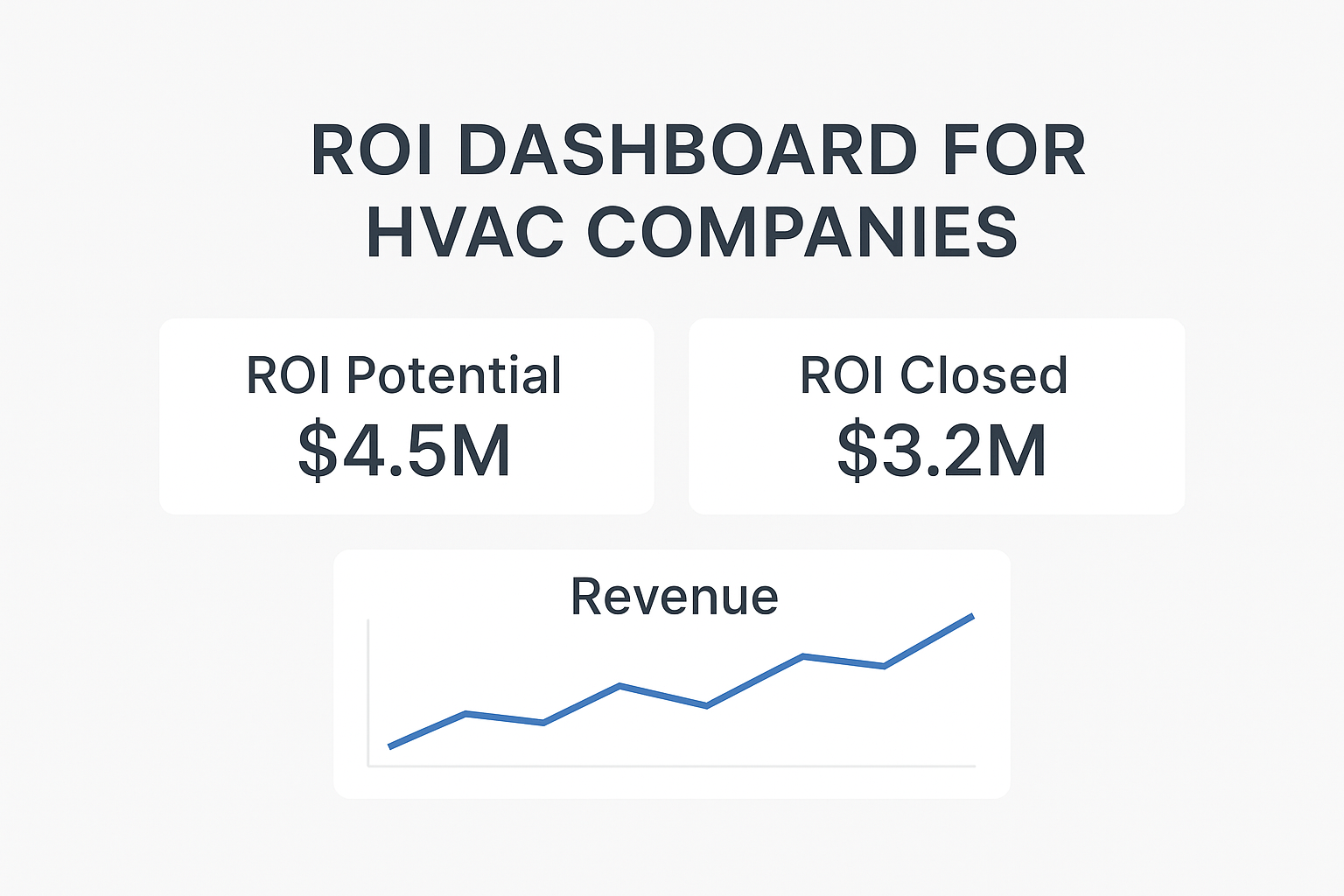
This is exactly why we use an ROI Dashboard, the industry’s most transparent, contractor-focused reporting platform designed specifically for HVAC companies.
The ROI Dashboard doesn’t just tell you what you spent and what you earned.
It reveals:
- Which marketing channels make you money (and which drain it)
- How your CSRs influence revenue outcomes
- Where your Comfort Advisors lose opportunities
- How many leads you should have closed
- How much revenue is being left on the table every month
- The true ROI of both marketing and sales efforts
In this in-depth guide, we’ll break down:
- The biggest problems HVAC companies face that the ROI Dashboard solves
- Why most HVAC companies dramatically under-report their actual ROI
- The critical distinction between ROI Potential and ROI Closed
- How that distinction helps you train CSRs and Comfort Advisors more effectively
- How the All Contractor Marketing ROI Dashboard gives HVAC companies a massive competitive edge
The Problems HVAC Companies Face—and Why Most Are Flying Blind
Most HVAC owners we meet are excellent technicians, great leaders, and passionate business builders. But almost none of them have real visibility into what is happening inside their marketing and sales pipeline.
They usually see symptoms—
Not the causes.
They know:
- “My marketing seems expensive.”
- “My CSRs don’t always book well.”
- “My comfort advisors tell me leads are low quality.”
- “My replacement sales fluctuate and I don’t know why.”
- “It feels like we are missing opportunities.”
But they don’t have the data to connect the dots.
Without the right numbers, owners end up:
❌ Making decisions based on emotion instead of fact
Cutting marketing that was actually profitable…
Investing more in campaigns that weren’t…
Hiring when they needed training instead…
Training when they actually needed new staff…
❌ Not understanding the REAL value of every lead
Many HVAC companies only count closed revenue. But that hides the true opportunity.
❌ Accepting poor performance because it’s invisible
You can’t fix what you don’t see.
You can’t improve what you don’t measure.
❌ Relying on incomplete reporting from marketing platforms
Google Analytics doesn’t tell you revenue.
LSA reporting doesn’t tell you closing rates.
CallRail doesn’t tell you how many leads you SHOULD have booked.
CRMs rarely connect marketing → calls → bookings → tickets → revenue.
So HVAC owners end up with fragmented data, which leads to fragmented decisions.
All Contractor Marketing uses an ROI Dashboard to solve this exact problem.
What Makes our ROI Dashboard Different
Other dashboards show clicks, impressions, phone calls, or cost per lead.
Those metrics are useful, but they are NOT business metrics.
What HVAC owners really need to see is:
- Revenue tied directly to marketing campaigns
- Lead quality by marketing channel
- CSR booking rate in real time
- Conversion percentage by Comfort Advisor
- Closed revenue vs. potential revenue
- Profitability per lead source
- Return on marketing spend factoring in missed opportunities
This is where our ROI Dashboard excels.
It integrates:
- Call tracking
- CRM job data
- Sales totals
- Lead sources
- Marketing expenses
- CSR performance
- Comfort Advisor performance
…into one clean, simple dashboard that tells the true story of your HVAC business.
Owners can finally answer:
- “Where is my money actually going?”
- “Which channels produce the highest revenue?”
- “Are my CSRs underperforming?”
- “Are my Comfort Advisors leaving money on the table?”
- “What is my REAL ROI?”
And perhaps most importantly…
- “What should my ROI have been if my team had performed at standard HVAC industry benchmarks?”
This brings us to one of the most powerful concepts in the HVAC business.
ROI Potential vs. ROI Closed — The Single Most Important Metric HVAC Owners Don’t Track
In HVAC marketing, business owners almost always look at ROI Closed.
That’s the revenue the company actually booked and completed.
But here’s the problem:
ROI Closed only tells part of the story.
It fails to show how much your business should have made based on:
- The number of leads generated
- How many of those leads should have been booked
- How many booked calls should have turned into sales
- How much revenue should have closed at industry-standard performance levels
This is why we created ROI Potential, one of the most valuable metrics inside the ACM ROI Dashboard.
ROI Potential answers these questions:
- What would my revenue have been if CSRs booked at best-practice rates?
- What would my revenue have been if Comfort Advisors closed at typical HVAC closing rates?
- What revenue did my marketing truly produce—after adjusting for internal performance issues?
Here’s a simple way to understand it:
🔵
ROI Closed = What Actually Happened
🔵
ROI Potential = What Should Have Happened
(based on industry benchmarks, call volumes, and actual lead flow)
If ROI Closed is significantly below ROI Potential, you know instantly:
- CSRs need booking training
- Comfort Advisors need sales training
- Lead routing needs improvement
- Pricing might be hurting conversions
- Your team is not maximizing the leads your marketing is generating
For the first time, the HVAC owner can separate:
- Marketing problems
from - Operational problems
And THAT is a game-changer.
Why HVAC Companies MUST Understand ROI Potential vs. ROI Closed
Let’s break down how this affects each department.
CSR Performance: The Hidden Profit Drain in Most HVAC Companies
Most HVAC owners don’t realize how many opportunities are lost at the first point of contact—the phone.
If your CSR team books:
- 40% of calls → major revenue loss
- 60% of calls → still below HVAC best practices
- 80%+ → strong booking rate
The industry benchmark is usually 70–85%, depending on lead type.
But without data, CSRs often sound busy and productive…
While the numbers tell a different story.
ROI Potential exposes CSR issues instantly.
The dashboard shows:
- How many leads came in
- How many SHOULD have been booked
- How many were ACTUALLY booked
- The revenue value of those missed bookings
When owners see these numbers for the first time, they usually say:
“I had no idea we were losing this much money at the phones.”
It’s not unusual for a company doing $3M/year to be losing $30,000–$80,000 per month in unbooked opportunity…
And they never knew it.
This is exactly why understanding ROI Potential is so critical.
Comfort Advisor Performance: Measuring True Sales Effectiveness
After the CSR books the call, the next bottleneck is the Comfort Advisor.
If your Comfort Advisor:
- Closes at 20–30% → below average
- Closes at 40–50% → strong
- Closes at 60%+ → excellent
But what if you don’t track it?
If you only see the final revenue numbers, you may assume:
- The leads were bad
- Marketing isn’t working
- Customers weren’t ready
- Budget was the problem
- The season was slow
But many times:
**The leads were great.
The marketing was excellent.
The opportunity was there.
The close rate simply wasn’t.**
This is why tracking ROI Potential is essential.
It shows:
- How many sales SHOULD have closed
- How much revenue SHOULD have been generated
- Which Comfort Advisor is underperforming
- Which lead types they struggle with
- How much revenue you missed because of low conversion
This is not about blaming your team—it’s about creating visibility, so you can create improvement.
How ROI Potential + ROI Closed Helps You Train CSRs and Comfort Advisors
The moment you see the difference between what happened and what should have happened, training becomes targeted and effective.
Training becomes data-driven, not opinion-driven.
Here’s how this transforms each role.
How It Improves CSR Training
When you know your booking rate should be 80% but your team is at 55%, you can immediately:
- Identify call types affecting performance
- Pull recordings for specific training opportunities
- Improve scripts and objection handling
- Implement CSR scorecards
- Train on empathy, urgency, and value communication
Imagine showing your CSR team:
- “We missed $42,000 in booked revenue this month from unbooked calls.”
It changes their entire mindset.
The data motivates improvement.
How It Improves Comfort Advisor Training
If you know your Comfort Advisor should be closing 45% but is only closing 28%, you can start:
- Reviewing estimates
- Evaluating follow-up process
- Checking financing presentation
- Improving value-building techniques
- Reviewing price presentation strategy
- Reinforcing comfort-based sales discovery
The ROI dashboard can even show:
- Low close rate on high-quality leads
- Strong close rate on certain lead types
- Patterns in missed sales
- Underpricing or overpricing issues
Instead of guessing what training they need…
The dashboard tells you.
How It Improves Marketing Decisions
Perhaps the biggest benefit of all:
You finally know whether poor results come from marketing or operations.
If:
- ROI Potential is high
- ROI Closed is low
→ Your marketing is working. Your team needs training.
If:
- ROI Potential is low
- ROI Closed is low
→ Your marketing needs improvement.
No emotion.
No guessing.
Just clarity.
The ROI Dashboard in Action: A Realistic Scenario
Let’s walk through an example using round numbers.
Month Summary
- 100 leads generated
- Average HVAC ticket: $7,500
- CSR booking rate: 55%
- Industry standard booking: 80%
- Comfort Advisor close rate: 28%
- Industry standard close rate: 45%
1. Leads Generated
100 leads came in from marketing.
2. CSR Booking Performance
At industry standards, you should have booked:
80 bookings (ROI Potential)
You actually booked:
55 bookings (ROI Closed)
→ You lost 25 booked calls right at the phone.
If each booked appointment has a sales potential of $7,500…
You lost $187,500 in potential revenue before a Comfort Advisor ever had a chance.
3. Comfort Advisor Sales Performance
Of the 55 appointments:
- Industry standard: 45% close rate → 25 sales
- Actual close rate: 28% → 15 sales
You lost 10 sales opportunities.
10 missed sales × $7,500 average ticket = $75,000 lost revenue.
4. Total Lost Opportunity
CSR losses: $187,500
Sales losses: $75,000
TOTAL LOST POTENTIAL: $262,500
Your marketing didn’t fail.
Your leads didn’t fail.
Your visibility failed—and now it’s fixed.
This is exactly what the ACM ROI Dashboard reveals.
Benefits HVAC Companies Get When They Use the ROI Dashboard
Here is what our clients tell us regularly.
1. They Understand Their Business Better Than Ever Before
Owners make cleaner, faster, smarter decisions.
The fog lifts.
The numbers finally make sense.
2. CSR and Comfort Advisor Performance Improves Dramatically
What gets measured gets improved.
Our clients consistently report:
- Higher booking rates
- Higher closing rates
- Higher average tickets
- Fewer wasted leads
- More consistent team performance
Training becomes strategic, not reactive.
3. They Stop Over- or Under-Investing in Marketing
You know:
- Which channels print money
- Which channels produce junk leads
- Where to scale your budget
- Where to cut back
Your marketing spend becomes more profitable and more predictable.
4. They Increase Revenue Without Increasing Lead Cost
Most HVAC companies don’t need more leads.
They need to maximize the leads they already get.
ROI Potential exposes the bottlenecks so revenue rises without increasing marketing spend.
5. They Hold Vendors, CSRs, and Comfort Advisors Accountable
With transparent performance data:
- No more “the leads are bad.”
- No more “the calls weren’t good.”
- No more “marketing isn’t working.”
Data creates accountability—fair, clear, unemotional accountability.
6. They Finally Know Their True ROI
Not the ROI of closed revenue only…
But the ROI their business could have achieved with proper performance.
This empowers growth decisions like:
- Hiring
- Training
- Expanding service areas
- Investing in new marketing channels
- Adjusting pricing
- Improving follow-up processes
The companies that scale the fastest understand ROI at the deepest level.
Why HVAC Companies Can Trust All Contractor Marketing
All Contractor Marketing has been in the HVAC marketing space for nearly 20 years.
We’ve worked with hundreds of HVAC companies—from small family businesses to multi-location operations.
Our founders come from HVAC.
Our team lives and breathes HVAC.
We understand the industry’s challenges because we’ve lived them.
The ROI Dashboard reflects:
- Two decades of HVAC marketing experience
- Real-world performance benchmarks
- Proven training systems
- Deep understanding of HVAC sales and operations
- A mission to help contractors grow honestly, transparently, and profitably
We built the ROI Dashboard for HVAC businesses because no other platform understood HVAC the way we do.
The HVAC Companies That Grow the Fastest Know Their Numbers—Do You?
The All Contractor Marketing ROI Dashboard exists for one purpose:
To give HVAC companies complete visibility into marketing, CSR performance, Comfort Advisor performance, and revenue outcomes—so owners can make better decisions and grow faster with confidence.
Understanding ROI Closed vs. ROI Potential is one of the most powerful insights an HVAC business can have.
It reveals:
- The truth about your marketing
- The truth about your CSR performance
- The truth about your sales team
- The truth about your operational efficiency
- The truth about your revenue potential
And once you know the truth—you can fix it, scale it, and profit from it.
If you want:
- More revenue
- Higher close rates
- Better booking performance
- Clear reporting
- Stronger marketing ROI
- A powerful competitive edge
Then the All Contractor Marketing ROI Dashboard is not just helpful—it’s essential.
Want to See Your ROI Potential?
Book a Demo of the ACM ROI Dashboard Today.
Let us show you:
- How much money your company is leaving on the table
- How to turn more leads into revenue
- How to train your CSRs and Comfort Advisors using your own data
- How to scale your marketing the smart way
- How All Contractor Marketing can help you grow faster than ever before
→ Visit AllContractorMarketing.com to schedule your ROI Dashboard demo.